CalibGraph
A robust multi-camera calibration and health-monitoring system for cameras mounted on different moving links of an articulated robot. The project connects classical hand–eye calibration to observability, robust graph refinement, mechanical-drift isolation, camera–robot time synchronization, and held-out task-space error.

Headline results
The final evaluation uses separate calibration and validation trajectories. Results therefore measure downstream robot-frame task error rather than only fit residuals on calibration observations.
System architecture
Frame model and optimization
The transform convention is T_A_B: coordinates in frame B mapped into frame A. For camera C_i on link L_i:
p_A   = T_A_B @ p_B
T_A_C = T_A_B @ T_B_C

T_B_T = T_B_L_i(q_t) @ T_L_i_C_i @ T_C_i_T(t)
Relative motions recover the classical equation A_k X = X B_k. The joint graph minimizes a normalized six-dimensional SE(3) consistency residual:
E_i,t = inverse(T_B_T) @ T_B_L_i(t) @ T_L_i_C_i @ T_C_i_T(t)

r_i,t = [
  translation(E_i,t) / sigma_translation,
  LogSO3(rotation(E_i,t)) / sigma_rotation
]
When the camera and robot clocks differ, the carrying-link pose must be evaluated at t + delta_i rather than at the camera timestamp alone.
T_B_T =
  T_B_L_i(t + delta_i)
  @ T_L_i_C_i
  @ T_C_i_T(t)
Motion observability before solver selection
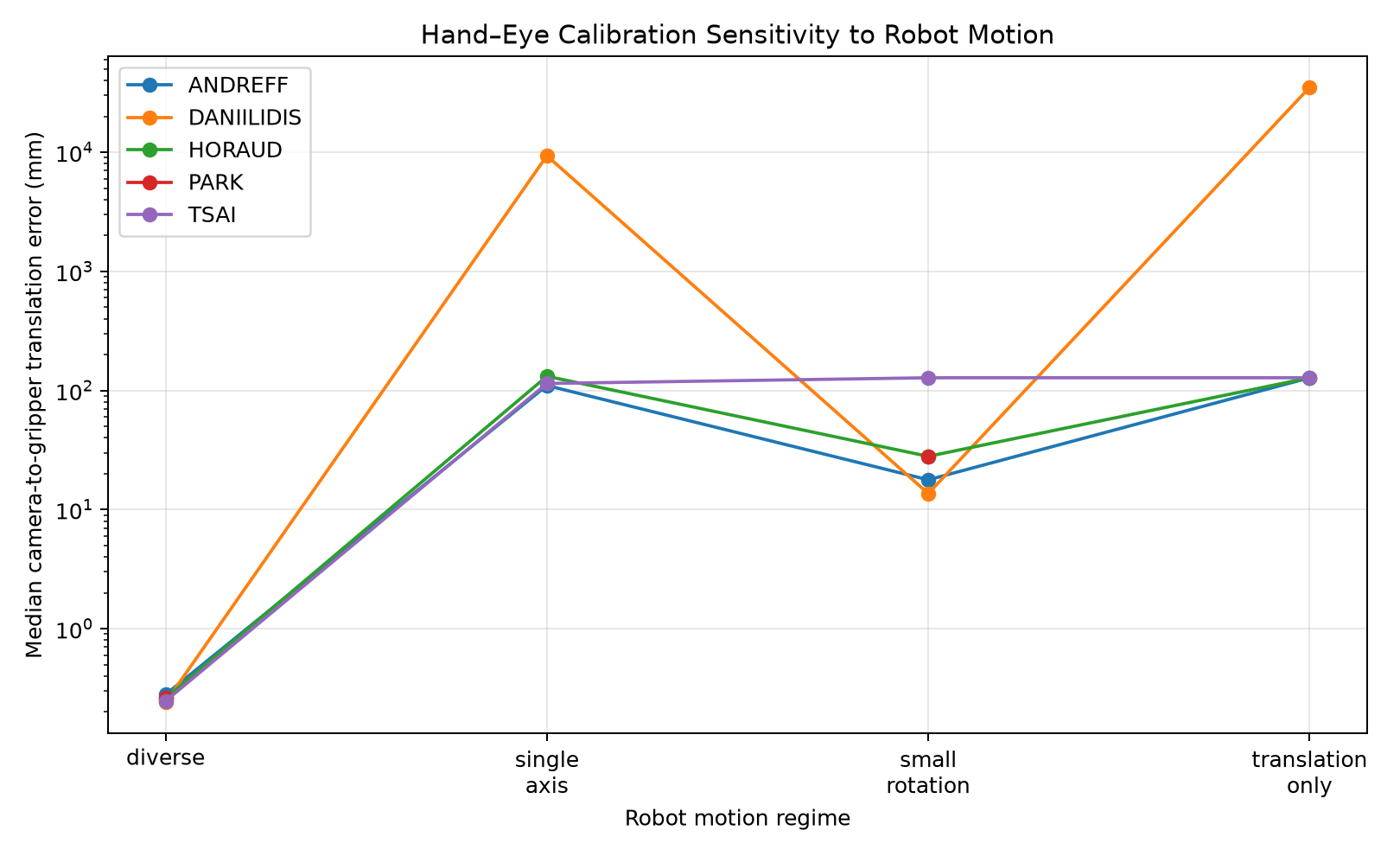
The same solver can be accurate or catastrophic depending on the calibration trajectory. CalibGraph measures angular excitation, axis diversity, translation baseline, and design rank before trusting the result.
| Motion regime | Rotation rank | Quality | Engineering interpretation |
|---|---|---|---|
| Diverse multi-axis motion | 8 | GOOD | Well observed |
| Single-axis motion | 6 | POOR | Rotation not uniquely constrained |
| Small rotations | 8 | POOR | Full rank but practically ill-conditioned |
| Translation only | 0 | POOR | No rotational observability |
Robust joint refinement is condition-dependent
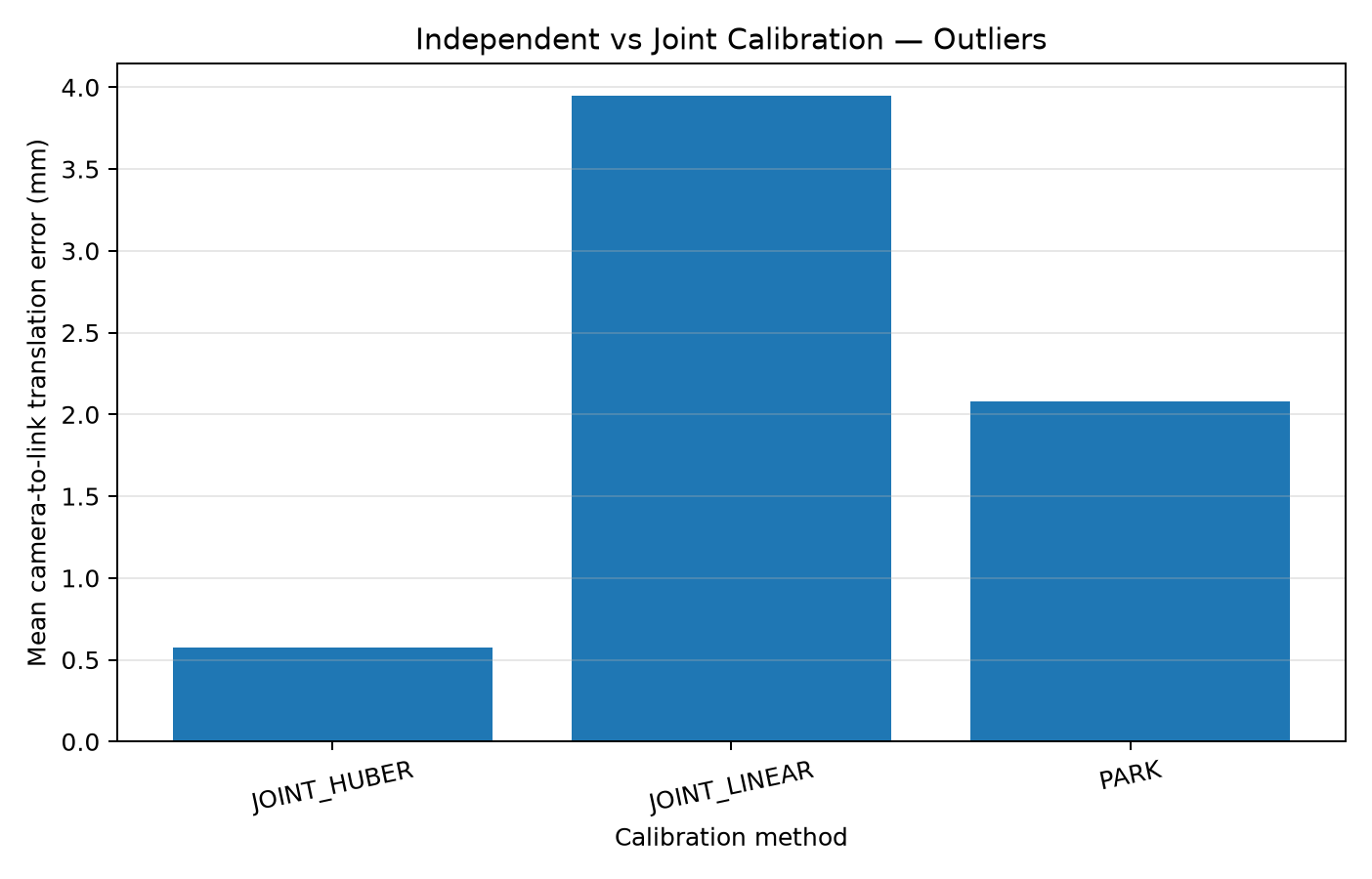
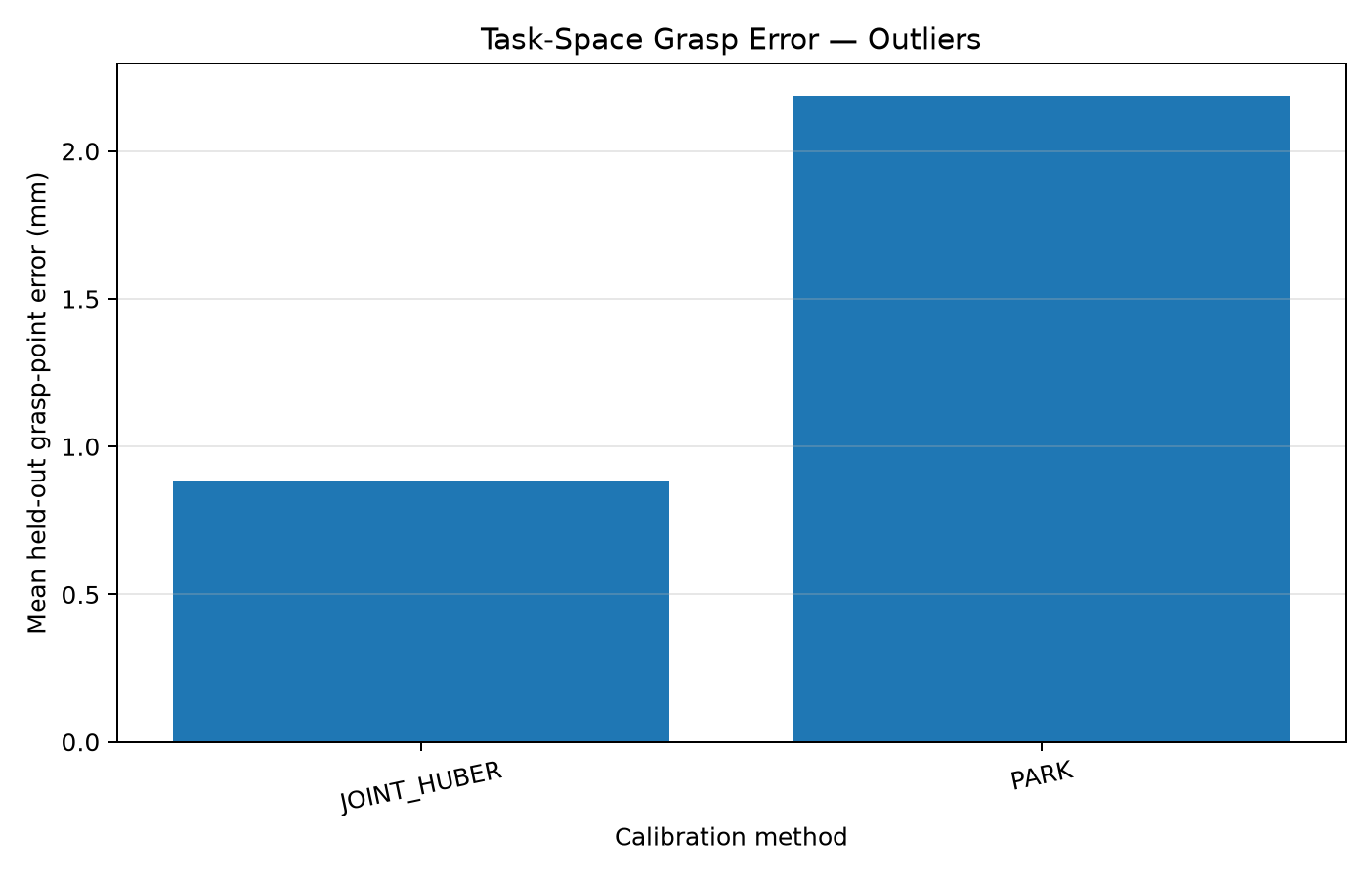
Joint optimization was not automatically better. Under clean Gaussian observations, PARK was both faster and more accurate. Under 8% gross target-pose outliers, Huber refinement prevented corrupted factors from pulling all camera estimates away from the shared target.
| Calibration condition | Method | Mean grasp error | Precision acceptance | Mean calibration runtime |
|---|---|---|---|---|
| Gaussian | PARK | 0.727 mm | 98.9% | 14.1 ms |
| Gaussian | Joint Huber | 0.765 mm | 98.9% | 427.5 ms |
| 8% outliers | PARK | 2.186 mm | 45.6% | 14.0 ms |
| 8% outliers | Joint Huber | 0.882 mm | 96.1% | 472.9 ms |
Mechanical drift monitoring and camera isolation
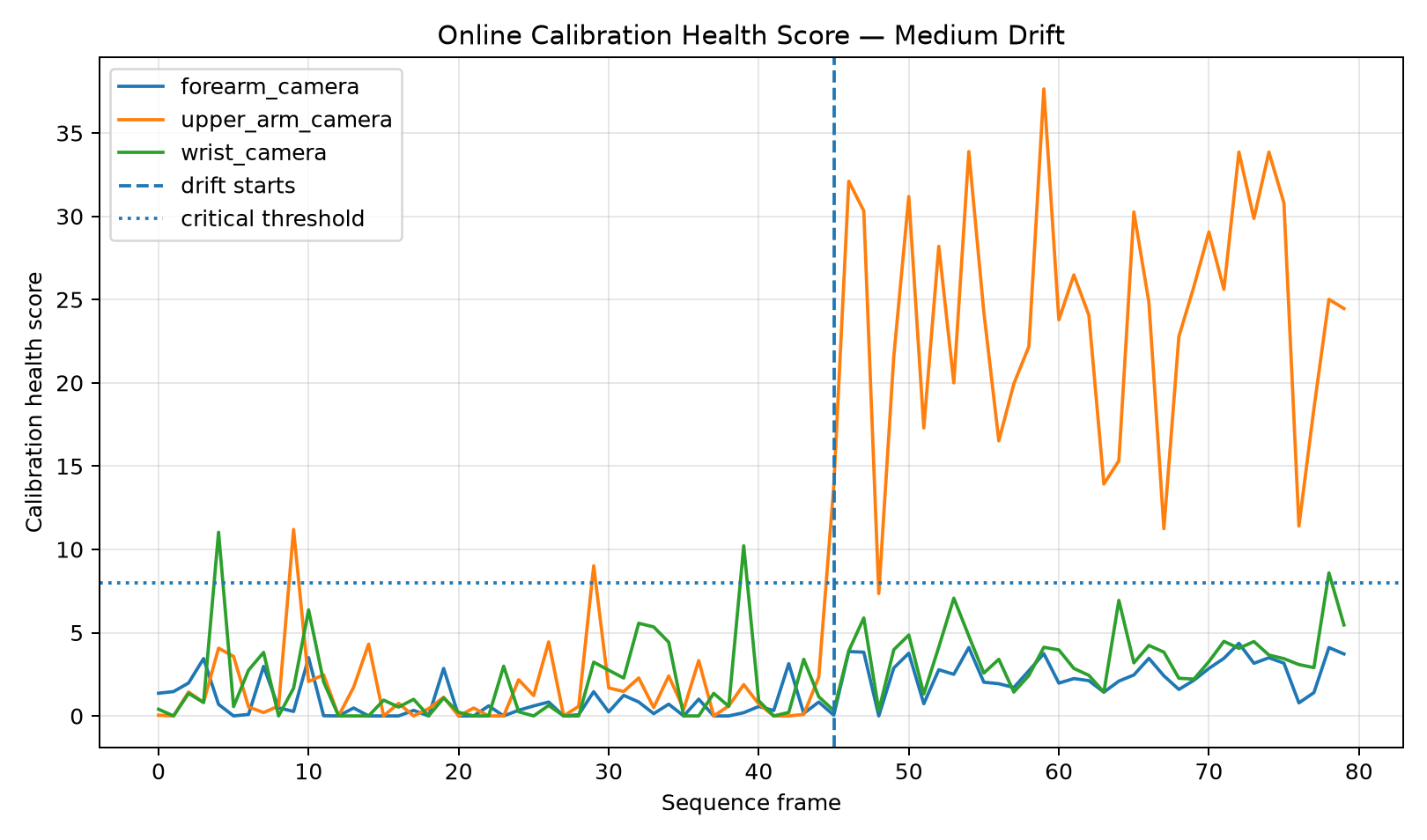
The monitor learns robust healthy residual distributions from an initial calibration window. Persistent critical scores request recalibration. Raw cross-camera disagreement detects that the system is unhealthy; leave-one-camera-out consistency identifies the mount most likely to have moved.
z = max(0, (error - median(error)) / max(1.4826 * MAD, minimum_scale))

health = sqrt(z_translation² + z_rotation² + z_cross_camera²)

isolation(i)
  = mean distance(camera i, peers)
    - mean distance among the peers
| Injected drift | Detection | Correct camera isolation | False alarms |
|---|---|---|---|
| 1 mm / 0.2° | 55% | 55% | 0% |
| 3 mm / 0.5° | 100% | 95% | 0% |
| 8 mm / 1.5° | 100% | 100% | 0% |
Camera–robot time synchronization
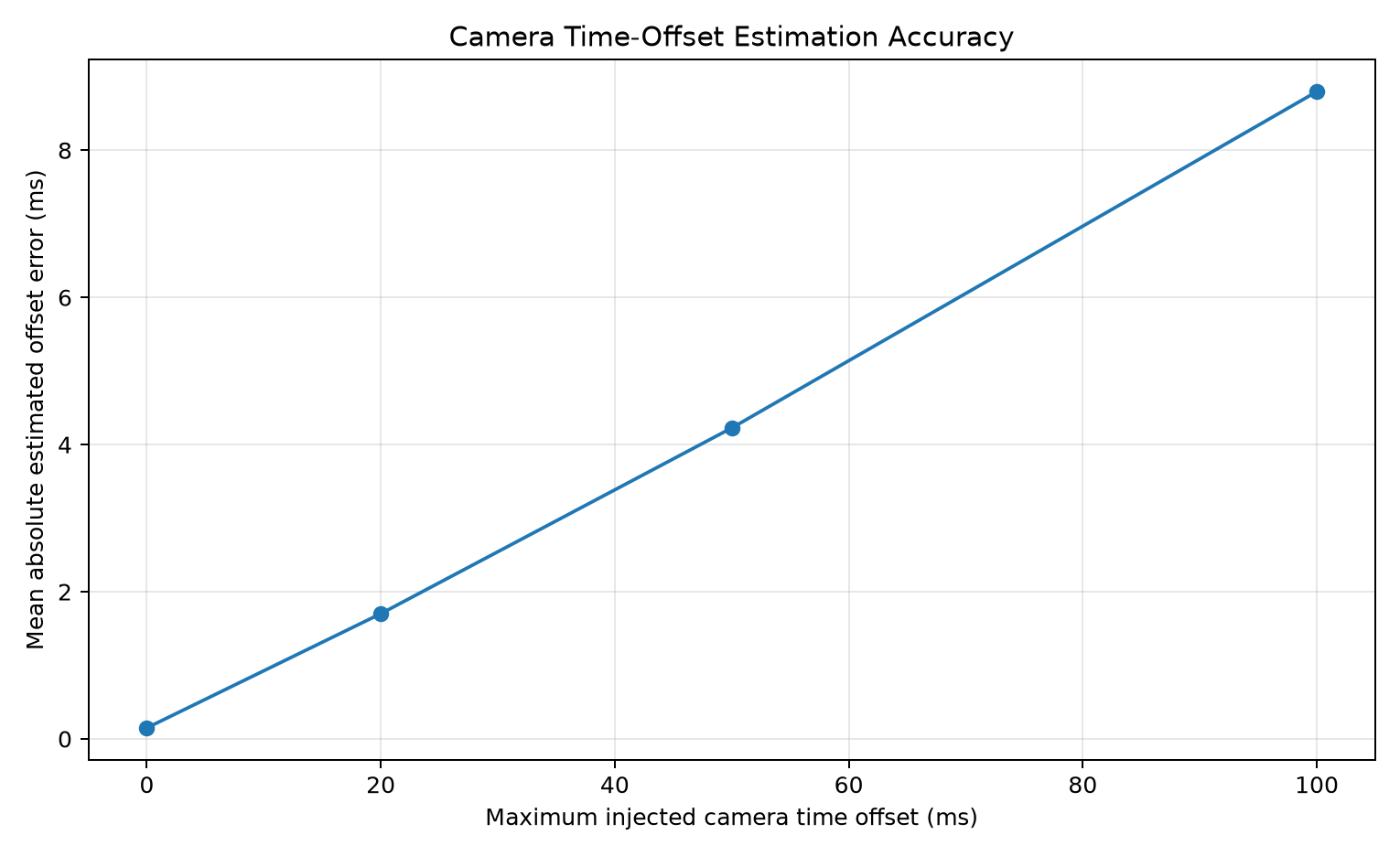
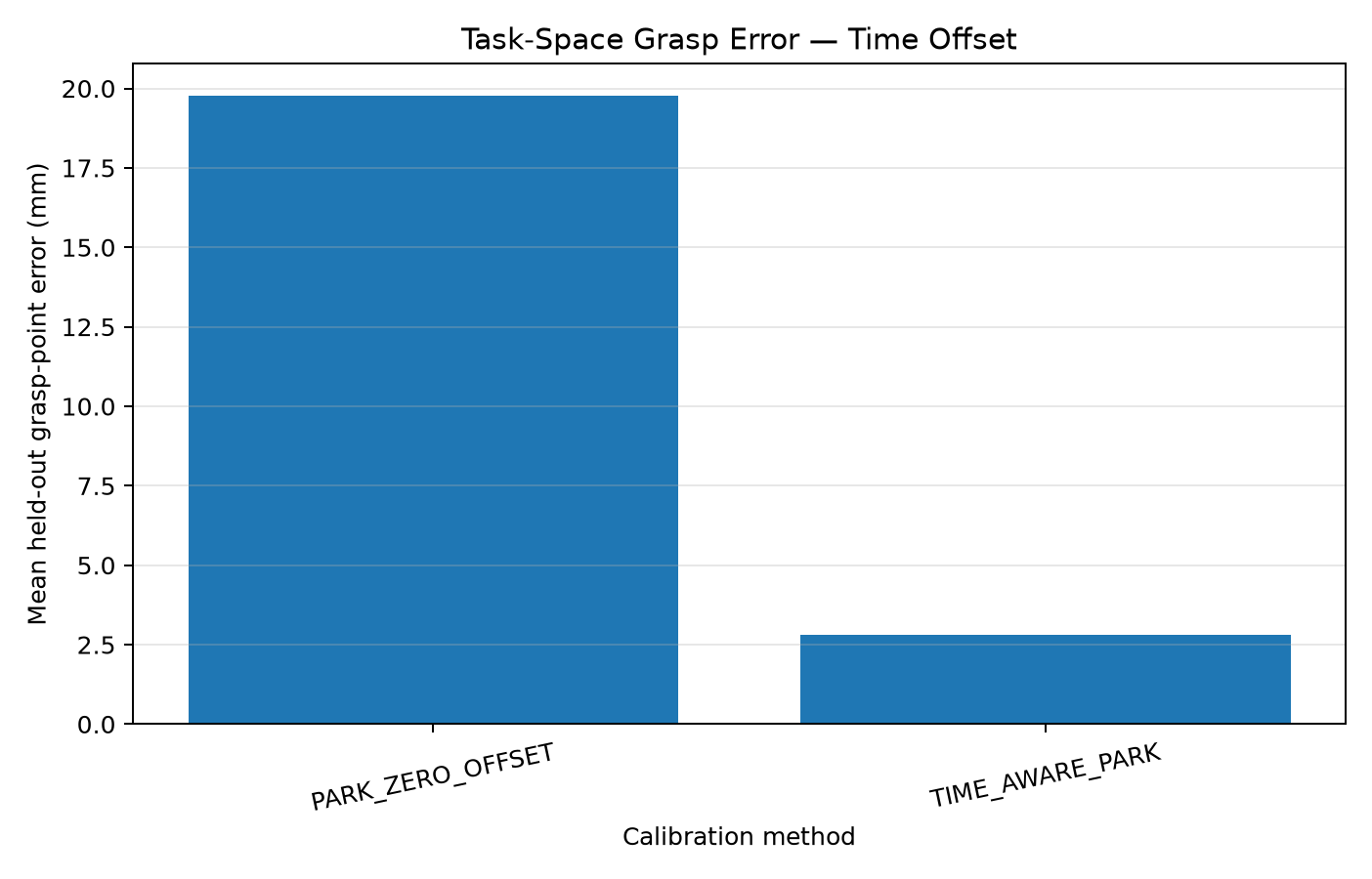
On moving links, pairing an image with the wrong encoder timestamp creates an apparent extrinsic error. CalibGraph alternates between PARK calibration and bounded per-camera time-offset estimation.
| 100 ms offset-level metric | Zero-offset PARK | Time-aware PARK | Reduction |
|---|---|---|---|
| Extrinsic translation error | 18.03 mm | 2.39 mm | 86.7% |
| Target localization error | 66.35 mm | 8.81 mm | 86.7% |
| Cross-camera disagreement | 70.97 mm | 9.38 mm | 86.8% |
| Mean time-offset error | 70.0 ms assumption error | 8.80 ms | 87.4% |
Reproduction
python3 -m venv .venv
source .venv/bin/activate
python -m pip install -r requirements.txt
python -m pip install -e .
python -m pytest -q

python scripts/benchmark_target_pose_noise.py
python scripts/benchmark_motion_observability.py
python scripts/benchmark_multicamera_independent.py
python scripts/benchmark_joint_multicamera.py
python scripts/benchmark_drift_monitoring.py
python scripts/benchmark_time_synchronization.py
python scripts/benchmark_task_space_validation.py
The release contains source code, 34 tests, phase-by-phase technical notes, CSV summaries, raw trial tables, environment information, and generated figures.
Limitations and next validation step
- The current evidence is synthetic; no physical robot or real-camera experiment is claimed.
- Target observations are simulated as noisy SE(3) poses rather than estimated from raw corner detections.
- The nominal kinematic chain is exact unless a corruption experiment explicitly changes it.
- The time-aware method is an offline diagnostic and is much slower than closed-form PARK.
- Task-acceptance thresholds are explicit simulated geometric criteria, not a safety or production guarantee.